
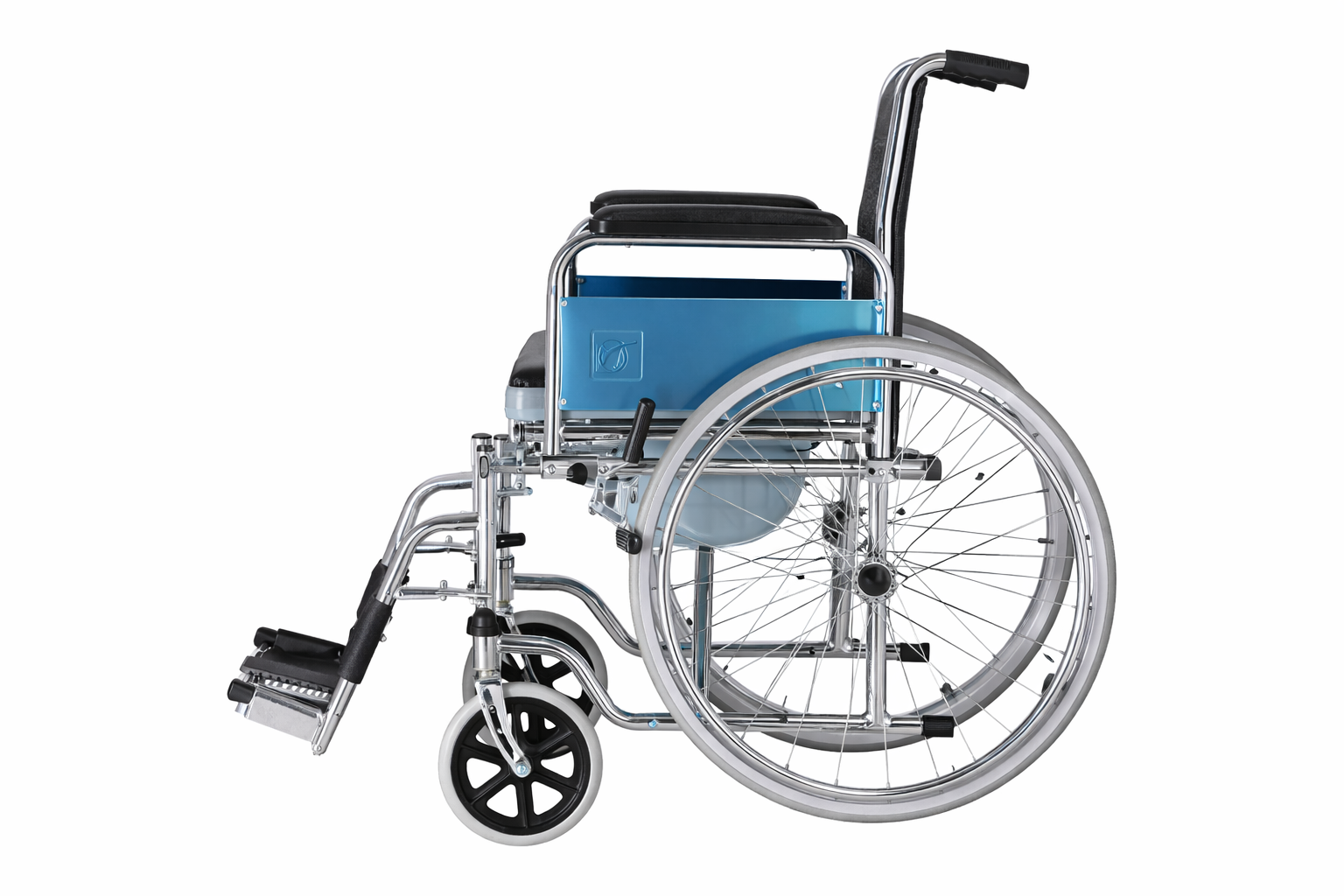
Best Wheelchair Prices in Kenya 2026: Types, Costs & Where to Buy
See current wheelchair prices in Kenya, compare types for home care, hospitals & bulk orders, and get nationwide delivery from a trusted supplier.
With Kans Med Supply, you’ll get fast delivery and dependable help every step of the way.
What Is a Wheelchair?
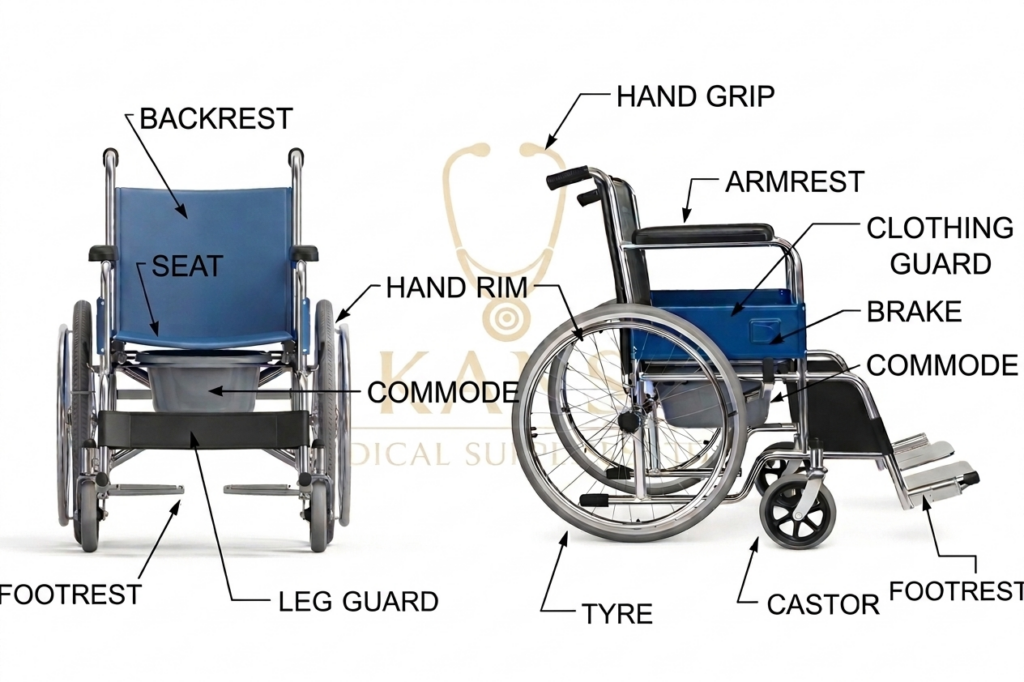
Photo of a labeled Commode Wheelchair for sale in Nairobi
A wheelchair is a tool that makes life easier for people who struggle to walk.
It gives people freedom and independence in sickness, injury, disability, or old age.
Which types of wheelchairs are available in Kenya?
- Manual
- Electric
- Reclining
- Commode
- Pediatric
- Cerebral Palsy
How Do I Choose the Right Wheelchair for a Patient?
A poorly chosen wheelchair can put the user at risk.
It might damage their health, cause sores, or be left aside because it is too uncomfortable.
When a wheelchair isn’t the right fit, it’s more likely to fail.
In fact, nearly 50% of wheelchairs in the United States require fixing within six months of use (Worobey et al, 2012).
The tables below show a simple guide to the main wheelchair types available in Kenya.
You’ll see when each one is most useful and the medical evidence that supports these recommendations.
Where can I buy certified medical wheelchairs locally?
1. Local Supplier Near You
Kenyan buyers who put reliability, compliance, and after‑sales service first should choose a respected local distributor.
It’s the safest and most reliable route.
Kans Med Supply is one of Kenya’s most trusted medical equipment distributors.
We serve hospitals, home care facilities, resellers, procurement teams, and everyday users across Kenya.
What are the benefits of buying wheelchairs from local suppliers in Kenya?
- Convenient shopping: Local suppliers like Kans Med Supply stock manual wheelchairs, electric wheelchairs, reclining wheelchairs, commode wheelchairs, pediatric wheelchairs, and Cerebral Palsy wheelchairs. Click here to order.
- After-sales support: For electric wheelchair buyers, replacing batteries, diagnosing electrical problems, and handling basic maintenance are key.
- Fast delivery: Local distribution means you get what you need without long delays.
- Practical return policy: If any delivery is faulty, customers are covered and can return defective stock. (Remember to read the Return Policy for Online Shops before purchase)
- Discounted bulk buying: Local suppliers like Kans Med Supply support wholesale pricing and special discounts for bulk orders.
- Relationship building: Unlike imports that treat every order as just another sale, local suppliers invest in long‑term partnerships.
Shop certified wheelchairs now, visit kansmedsupply.co.ke to place your order and get the right wheelchair delivered hassle‑free.
2. Direct Import
Some institutions choose to import wheelchairs from manufacturers in China, India, Pakistan, or Europe, often to access specific models or bulk pricing.

Ship at Momabasa Port | Image Courtesy of The Standard
Buying in bulk lowers the price per unit, making large orders more cost‑effective.
What are the risks of buying wheelchairs through Direct Import in Kenya?
- Direct import deliveries can stretch from 6 to 12 weeks or longer.
- Lack of local support. Zero after‑sales service, returns, or warranty enforcement.
- Misleading price tag. Extra charges like import duties, port handling, and clearing fees eat into the savings buyers expect.
- Direct imports carry the risk of receiving products that fail to meet KEBS or KMPDC standards, leaving buyers exposed to compliance issues
[Read this article on Legal Requirements for Direct Import]

Image courtesy of Gemini for illustrative purposes
A mid-tier private hospital in Nairobi wanted to save money. The procurement team ordered 102 patient monitors straight from a company in Asia. They skipped local suppliers because the price looked almost 28% cheaper.
When the shipment landed at Jomo Kenyatta International Airport, KEBS inspectors stopped it. The patient monitors did not have the right certification marks. The supplier also failed to give the documents needed for KMPDC approval.
- The patient monitors stayed at customs for three months.
- The hospital had already removed some of its old monitors, leaving ICUs short of equipment.
- Patients were sent to other hospitals
- KEBS fined the hospital for trying to clear uncertified goods.
- The hospital had to buy new patient monitors from a local supplier at 30% higher cost.
What looked like a smart way to save money turned into a compliance crisis.
What are the key factors to consider when buying a wheelchair in Kenya?
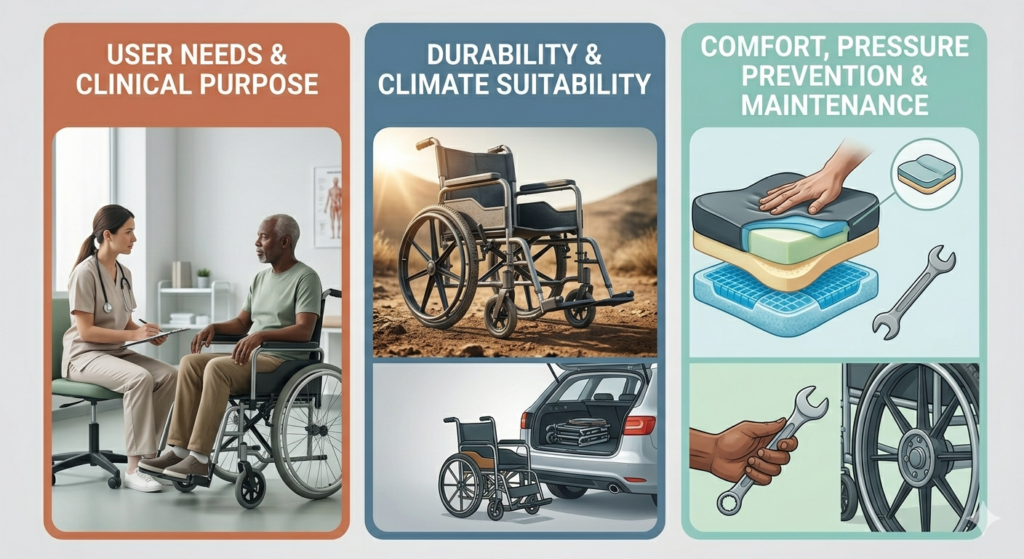
Image courtesy of Gemini for illustrative purposes
User Needs and Clinical Purpose
Determine whether the wheelchair is needed for short‑term recovery or long‑term use.
Self‑propelled chairs give users independence, while attendant‑propelled models work best when a caregiver is always available.
Durability and Climate Suitability
From the salty air at the coast to the cooler Rift Valley, Kenya’s climate can be tough on equipment.
Aluminium frames with powder‑coat finishes resist rust and wear in all climates.
For hospital or rehab use, choose models with reinforced cross‑braces and double‑stitched upholstery for extra strength.
Comfort and Pressure Injury Prevention.
Seats need a 2.5 cm clearance on each side and enough depth to support the thighs without knee pressure.
Padded seats, relief cushions, and adjustable footrests are essential for safety, comfort, and long‑term well-being. NPUAP/EPUAP (2014).
Portability
For people using matatus, cars, or public transport, a foldable wheelchair is a must.
It should fold to less than 30 cm wide to fit in a boot.
Light designs under 15 kg make life easier for caregivers handling daily travel
Terrain Suitability
Standard wheels work well in cities like Nairobi, Mombasa, Nakuru, Eldoret, and Kisumu.
In rural areas with rough roads or gravel, buyers should look for pneumatic tyres, larger rear wheels, and stronger frames.
Some users may even need all‑terrain models for outdoor use.
Weight capacity
Standard wheelchairs safely carry 100–120 kg.
Heavier users need bariatric models with reinforced frames and wider seats, supporting 150–250 kg.
Exceeding weight limits causes faster wear and serious safety risks, so always confirm the user’s weight before buying.
Maintenance
Maintenance keeps a wheelchair safe and reliable. Always confirm your supplier stocks spare parts.
For electric models, battery replacement is the most common need; Kans Med Supply’s biomedical technicians handle this directly.
The parts most likely to wear out are tyres, tubes, armrests, and footrests.
What are the most common mistakes buyers make when purchasing wheelchairs?

A patient struggling to use her wheelchair
Wrong size selection
Many people think wheelchairs come in a standard size, but that’s not true.
The seat’s width, depth, and back height need to fit the user.
If the seat is too wide, it’s harder to move around. If it’s too narrow, the user may develop painful pressure sores.
Overlooking Lifestyle Needs
Wheelchair choice should match daily life.
Indoor chairs aren’t ideal outdoors, and outdoor models may be too large indoors.
For people on the move, foldable lightweight designs make travel easier and more comfortable.
Overlooking Comfort
Many buyers forget about comfort.
Basic wheelchairs lack enough cushioning, which can cause back pain/poor circulation.
Pressure‑relief cushions and ergonomic designs are important for long‑term use.
Skipping a professional recommendation.
Medical experts help match the wheelchair to the user’s body, reducing the risk of posture problems and equipment misuse.
A qualified occupational therapist or physiotherapist should ideally be consulted for long-term users
Focusing only on Price
Cheaper wheelchairs often lack durability or flexibility, and repair or replacement costs over time outweigh the initial savings
Choosing aesthetics over function
Some buyers choose wheelchairs for looks or light frames, but forget that seat design and padding are what truly determine daily comfort.
Not involving the patient in wheelchair selection
Including the user in the wheelchair selection process often leads to good outcomes (Borg et al, 2012).
How can I ensure a wheelchair meets Kenyan medical standards?
Wheelchair standards in Kenya are based on ISO guidelines and formalized as Kenya Standards (KS).
The KS ISO 7176 Series is the global standard for wheelchair safety and design.
- KS ISO 7176‑1: Defines how stability is tested.
- KS ISO 7176‑8: Sets strength and fatigue requirements.
- KS ISO 7176‑15: Covers documentation and labeling rules.
- KS ISO 7176‑10: Explains how electric wheelchairs must climb obstacles safely.
The Pharmacy and Poisons Board (PPB) regulates medical devices such as wheelchairs, ensuring they meet strict standards before reaching users.
Kenya Bureau of Standards (KEBS): Imported medical equipment should carry the KEBS mark of quality or have documents proving compliance with Kenyan Standards (KS) or equivalent international standards.
CE Marking (European Conformity): A CE mark on a wheelchair shows it complies with MDR 2017/745, proving it has passed safety and performance testing.
Kans Med Supply sources wheelchairs from manufacturers with documented ISO 7176 and CE compliance, and can provide relevant test certificates upon request.
Does SHA provide comprehensive coverage for wheelchairs?

Image courtesy of KENYA NEW AGENCY
NO. Wheelchairs aren’t fully covered under Kenya’s Social Health Authority (SHA).
Buyers pay out‑of‑pocket or rely on hospital procurement and charitable programs.
Patients in Kenya usually get wheelchairs through three main routes:
- Private purchase from medical suppliers such as Kans Med Supply or local distributors.
- Hospital procurement programs that supply chairs to patients
- NGOs and charities like APDK or Motivation Africa.
You can use this final checklist as a quick guide when purchasing your wheelchair
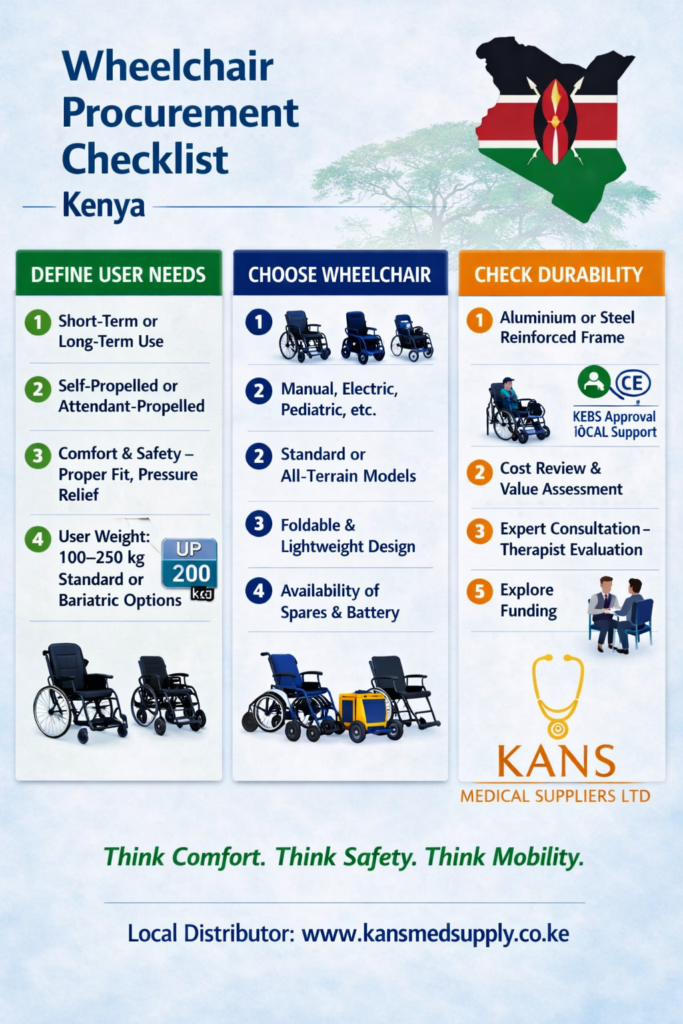
Contact Kans Med Supply today to discuss your wheelchair needs and receive a customised quote.
References
European Parliament. (2017). Regulation (EU) 2017/745 on Medical Devices (MDR). Official Journal of the European Union.
World Health Organization (WHO). (2008). Guidelines on the Provision of Manual Wheelchairs in Less Resourced Settings. Geneva: WHO Press.
WHO/USAID. (2012). Wheelchair Service Training Package (WSTP) — Basic Level. Geneva: WHO.
Auger, C., et al. (2010). Powered mobility for middle-aged and older adults: Systematic review of outcomes and appraisal of published evidence. Disability and Rehabilitation: Assistive Technology, 5(2), 70-82. DOI: 10.3109/17483101003793281.
National Pressure Ulcer Advisory Panel (NPUAP) / European Pressure Ulcer Advisory Panel (EPUAP). (2014). Prevention and Treatment of Pressure Ulcers: Clinical Practice Guideline. Washington, DC: NPUAP.
Rehabilitation Engineering and Assistive Technology Society of North America (RESNA). (2012). RESNA Position on the Application of Seating Technology. Arlington, VA: RESNA.
Wynter, M., et al. (2015). Postural management for children with cerebral palsy: A systematic review. Cochrane Database of Systematic Reviews, Issue 11. DOI: 10.1002/14651858.CD008851.pub2.
International Organization for Standardization (ISO). (2016). ISO 7176-15: Wheelchairs — Part 15: Requirements for information disclosure, documentation and labelling. Geneva: ISO.
International Organization for Standardization (ISO). (2018). ISO 7176-25: Wheelchairs — Part 25: Batteries and chargers for powered wheelchairs. Geneva: ISO.
Kenya Bureau of Standards (KEBS). Medical Devices Standards. Available at: www.kebs.org.
What Is a Wheelchair?
– A wheelchair is a tool that makes life easier for people who struggle to walk.
– It gives people freedom and independence in sickness, injury, disability, or old age.
Which types of wheelchairs are available in Kenya?
– Manual
– Electric
– Reclining
– Commode
– Pediatric
– Cerebral Palsy
How Do I Choose the Right Wheelchair for a Patient?
– User Needs and Clinical Purpose
– Durability and Climate Suitability
– Comfort and Pressure Injury Prevention
– Portability
– Terrain Suitability
– Weight capacity
– Maintenance
Where can I buy certified medical wheelchairs locally?
Kans Med Supply is one of Kenya’s most trusted medical equipment distributors.
– Kans Med supplies a wide range of wheelchairs to hospitals, home care facilities, resellers, procurement teams, and everyday users across Kenya
What are the most common mistakes buyers make when purchasing wheelchairs?
– Not involving the patient in wheelchair selection
– Choosing aesthetics over function
– Focusing only on Price
– Skipping a professional recommendation.
– Overlooking Comfort
– Overlooking Lifestyle Needs
– Wrong size selection
How can I ensure a wheelchair meets Kenyan medical standards?
Wheelchair standards in Kenya are based on ISO guidelines and formalized as Kenya Standards (KS).
Check:
1) KEBS mark of quality
2) A CE mark proving it has passed safety and performance testing
Does SHA provide comprehensive coverage for wheelchairs?
NO. Wheelchairs aren’t fully covered under Kenya’s Social Health Authority (SHA).
Buyers pay out‑of‑pocket or rely on hospital procurement and charitable programs
