

Commode Chair Buying Guide (Kenya 2026)
Discover how to choose the best commode chair in Kenya in 2026. Compare types, features, and prices to find the right option for hospitals, caregivers, and home use.

Author: Edwine Kanam, Medical Equipment Supply Specialist at Kans Med Supply
Reviewed by: Jane Ng’ang’a [Senior Registered Nurse | 15+ years of Experience in Nursing | Mama Lucy Level 5 Hospital, Nairobi]
Date Published: 2026-07-06
Last Updated: 2026-07-06
Primary_entity: Commode Chair
Entity_type: MedicalDevice / Product
Target_market: Kenya (Nairobi and nationwide)
Who is this guide for? Home caregivers, families, hospitals, rehabilitation centres, NGOs, clinicians, and anyone planning to buy or rent a commode chair in Kenya.
What Is a Commode Chair?
A commode chair is a portable toilet for people who cannot safely use a standard toilet because of age, illness, injury, surgery, or disability. It can be used beside the bed, over a toilet, or in the bathroom to make toileting safer and easier.
A commode chair is made up of four main components:
- Frame: Tubular steel, aluminium, or chrome-plated steel
- Seat: A circular or keyhole-shaped toileting opening
- Pail: A removable bucket with a lid for easy waste disposal
- Support structure: Armrests, backrest, and locking castors on mobile models

Infographic: SOURCE WHO Procurement
A commode chair improves safety, independence, and dignity by bringing a secure toileting solution within reach of people with limited mobility.
NEXT: Discover who needs a commode chair, the medical conditions it supports, and the key signs that indicate it’s time to consider one.
Who Needs a Commode Chair?
A commode chair is designed for people who have difficulty using a standard toilet safely. If pain, fatigue, or fear of falling makes bathroom trips difficult, a commode chair can provide a safer alternative.
Early use helps preserve independence, reduces fall risk, and makes caregiving easier.
A commode chair is commonly recommended for people who:
- Cannot safely walk to the bathroom without help
- Have poor balance or a history of falls
- Are recovering from surgery
- Experience severe joint pain or muscle weakness
- Need frequent toileting, especially at night
- Live in homes without indoor plumbing or where the bathroom is difficult to access
Infographic: Who needs a commode

If a patient has one or more fall risk factors, a commode chair can reduce unnecessary walking and make toileting safer.
Compare the main types of commode chairs available in Kenya to find the model best suited to the patient’s condition, mobility level, and home care environment.
Types of Commode Chairs Available in Kenya
Choosing the right commode chair starts with understanding how each type is designed to meet different mobility needs.
The best commode chair depends on:
- user’s medical condition
- mobility needs
- transfer ability
- available space
- where it will be used
Bedside Commode Chair (Static)

Image of a Static Bedside Commode Chair for Sale at Kans Med Supply
A bedside commode chair provides a toilet close to the bed, reducing the need to walk to the bathroom.
Most models have a removable bucket and can also fit over a standard toilet.
These models use fixed legs instead of wheels and have a lightweight frame for easy handling.
Best for: Older adults and people recovering after surgery.
Foldable Commode Chair

Image of a Foldable Commode Chair for Sale at Kans Med Supply
It is designed with a foldable frame for easy storage and transport.
Best for: Home use, travel, and recovery after surgery or injury.
Mobile Commode with Castors

Image of a Mobile Commode Chair with backrest and wheels for Sale at Kans Med Supply
This commode has lockable castors for safe patient transfers. Some models fit over a standard toilet, making toileting easier.
Best for: Stroke survivors, people with spinal injuries, and users with limited mobility. It supports safe, comfortable transfers while reducing caregiver strain.
Shower Commode Chair

Image of a Height Adjustable Shower Chair for Sale at Kans Med Supply
A shower commode is made for use in wet areas. Its waterproof, rust-resistant frame allows users to shower and use the toilet in the same chair, reducing transfers during personal care.
Best for: Users who need daily bathing support and long-term personal care.
Drop-arm commode

Image of a drop-arm commode
The armrests fold up or down, making side transfers safer and easier.
Best for: People recovering from a stroke or living with hemiplegia (a form of paralysis that affects only one side of the body).
Heavy-Duty Bariatric Commode Chair
Image of a bariatric Commode Chair for Sale at Kans Med Supply
These commodes have reinforced steel frames, wider seats, and higher weight limits to provide safe, stable support for larger users.
Best For: Patients above 100 kg
Commode Wheelchair (Sani-chair)

Image of a Standard Commode wheelchair for Sale at Kans Med Supply
Combines a wheelchair and commode in one unit. Large wheels allow users to move directly over a standard toilet. Most models have a removable bucket.
Best For: Patients needing both mobility and toileting in one device.
To learn more about other types of wheelchairs, explore our complete guide here.
Pediatric Commode/Potty Seat
Image of a Commode wheelchair Chair
These are designed with a compact frame and extra back support to improve comfort for children.
Best For: Children with limited mobility or developmental needs.
Customer Experience
Mzee Ngari, Retired Veterinary Officer, Nyeri County
For years, I woke up several times each night to use the toilet. Because our toilet is outside, every trip meant walking in the cold and darkness over uneven ground. I often worried about falling, and my sleep was always interrupted.
After my daughter saw me nearly slip one night, she suggested a bedside commode chair from Kans Med Supply. We ordered one through WhatsApp, and it was delivered to our home a few days later.
Using it has made a big difference. I no longer have to walk outside at night, I sleep better, and I feel more energetic during the day. It has given me greater confidence and peace of mind.
Today, I recommend a commode chair to anyone who struggles with frequent night-time trips to the toilet.
“Kama unaamka usiku kwenda haja, chukua commode. Ni pesa kidogo na inaleta sana amani.”
Asante sana, Kans Med Supply.
Which Type of Commode Chair Is the Most Popular in Kenya?
The foldable commode chair with castors remains the most requested model, making it the best commode chair in Nairobi based on customer preference.
Available in steel and aluminium models. Prices typically range from KSh 6,000 to KSh 20,000.
This is the most popular choice for many Kenyan homes. It is affordable, folds for easy storage, and has a removable bucket that makes cleaning quick and easy.

Foldable Commode with castors for sale in Nairobi
NOTE: No single commode chair suits everyone. Matching the chair to the user’s mobility and care setting improves safety, comfort, and long-term value.
Explore the prices, current buying trends, and a practical 2026 Nairobi price guide to help you plan your budget.
How Much Is a Commode Chair in Kenya? (2026 Price List for Nairobi)
The prices below come from a 2026 survey of Nairobi medical equipment suppliers and pharmacies. Prices may change over time, so confirm the current price with the supplier before making a purchase.
| Category | Indicative Price Range (KSh.) |
| Bedside Commode Chair (Static) | 6,000 – 10,000 |
| Drop-arm commode | 9,000 – 30,000 |
| Commode wheelchairs | 16,000 – 30,000 |
| Foldable Commode | 6,000 – 10,000 |
| Mobile commode with castors | 13,000 – 20,000 |
| Shower Commode | 9,500 – 80,000 |
| Heavy-duty (bariatric) commode | 15,000 – 200,000 |
| Pediatric Commode/Potty Seat | 15,000 – 40,000 |
| Rental services | Contact suppliers |
Several features affect the price. These include stainless steel frames, imported models, padded seats, drop arm designs, and bariatric weight capacities over 150 kg.
Buying tip: Look beyond the purchase price. A durable commode chair with available spare parts often lasts longer and offers better value than a cheaper model that needs early replacement.
Request a live quote: Visit our ecommerce website or call/WhatsApp +254 719382306 for today’s price and delivery options across Kenya. We stock spare parts for commode chairs.
How to Choose the Right Commode Chair
Choosing the right commode chair starts with the user’s medical needs, home environment, and how long it will be used.
The right chair improves safety, comfort, and independence while reducing the risk of falls and early replacement.
Before comparing brands, consider these six factors.
- Safety: Look for a stable frame, sturdy armrests, and locking wheels to reduce the risk of falls.
- Weight capacity: Pick a chair with a weight limit that matches the user. This helps keep the chair stable and safe.
- Hygiene: Look for smooth, non-porous surfaces and a removable bucket to make cleaning quick and reduce infection risk.
- Durability: Choose a rust-resistant frame that can handle daily use and humid conditions.
- Comfort: Choose the right seat width and height for safe and comfortable use.
- Warranty and spare parts: Choose a chair with available spare parts and a warranty for longer use.
Need a reliable commode chair? Order today via website for next‑day delivery in Nairobi. At Kans Med Supply, we stock durable models and genuine spare parts.
Don’t ask, “Which commode chair is the best?” Ask these questions instead:
- Can the user sit and stand without support?
- Will a caregiver help with transfers?
- Is the chair for temporary recovery or long-term care?
- Will it be used by the bed, over the toilet, or in the shower?
- Is there enough room for safe movement?
Expert tip: Pick a commode chair that supports both current and future needs. Adjustable models offer more flexibility and often provide better long-term value than fixed-height options.
Procurement Intelligence: Buy for Value, Not Just Price
For hospitals, rehabilitation centers, and home care providers, reliability matters as much as price. Dependable hospital equipment helps keep patient care on track and reduces unexpected costs.
A commode chair that lasts longer, is easy to clean, and has spare parts can save money over time. Cheap models often need to be replaced sooner.
Procurement Checklist
| Consider | What to Look For |
| Infection Control | Easy-to-clean, non-porous surfaces with a removable bucket for better hygiene. |
| Weight Capacity | A weight limit that exceeds the user’s weight for added safety. |
| Frame Quality | Powder-coated steel or aluminium that resists rust. |
| Ease of Cleaning | A simple design with fewer joints and crevices for better hygiene. |
| Spare Parts | Easy access to replacement buckets, rubber tips, and wheels. |
Need a durable commode chair with genuine spare parts? Call/WhatsApp +254 719 382 306 to speak with Kans Med Supply today. Visit www.kansmedsupply.co.ke.
Commode Chair Selection Scorecard
Use this weighted scorecard to rate each option from 1 to 10, apply the weight for each factor, and calculate a final score out of 10.
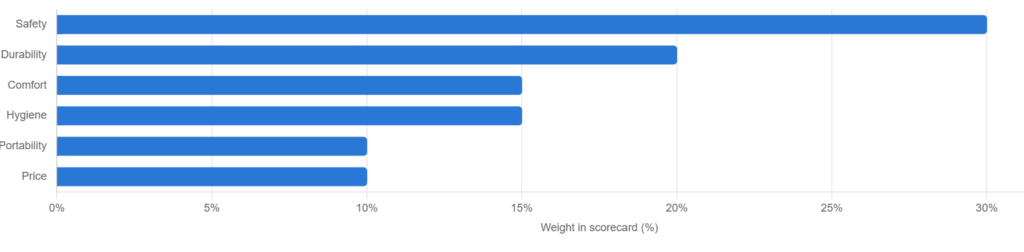
| Factor | Weight |
| Safety | 30% |
| Durability | 20% |
| Comfort | 15% |
| Hygiene | 15% |
| Portability | 10% |
| Price | 10% |
Worked example:
A mobile steel commode receives these scores:
Safety – 8/10, Durability – 7/10, Comfort – 6/10, Hygiene – 8/10, Portability – 9/10, Price – 6/10.
Final Quality Score = (8×0.30) + (7×0.20) + (6×0.15) + (8×0.15) + (9×0.10) + (6×0.10)
= 2.4 + 1.4 + 0.9 + 1.2 + 0.9 + 0.6
= 7.4/10
A total score above 7 out of 10 shows the chair is a strong choice for long-term home care and healthcare facilities.
Need commode chairs for your facility? Request a bulk order quote with volume discounts and delivery scheduling at www.kansmedsupply.co.ke.
Choose the Right Hospital Commode Chair by Patient Need
Start with this guide, then speak with a healthcare professional for advice based on the user’s needs.
| RATING | MEANING |
| 🟢 Recommended | The most suitable chair for this condition. |
| 🟡 Consider | Suitable in some cases, based on mobility and caregiver support. |
| ⚪ Not Preferred | Less suitable because safer or better options are available. |
Older Adults (Geriatric Care)
Ageing often brings reduced muscle strength, slower reflexes, poor balance, arthritis, and an increased risk of falls. A commode chair allows older adults to toilet safely without walking long distances, particularly at night when falls are most common.
| CHAIR TYPE | RECOMMENDATION |
| Bedside Commode Chair (Static) | 🟢 Recommended |
| Mobile Commode Chair with castors | 🟡 Consider (if caregiver-assisted) |
| Foldable Commode | 🟡 Consider (for temporary or travel use) |
Clinical Insight: Most older adults living at home benefit from a height-adjustable bedside commode with sturdy armrests for safety, comfort, and independence.
Explore our complete guide to mobility aids and discover products that improve safety, mobility, and independence.
Stroke Rehabilitation
Stroke often affects balance and movement. A wheeled commode chair helps reduce transfers and makes it easier for caregivers to move the user safely.
| CHAIR TYPE | RECOMMENDATION |
| Commode Wheelchair | 🟢 Recommended |
| Mobile Commode Chair with castors | 🟡 Consider |
| Foldable Commode | ⚪ Not Preferred |
Clinical insight: For safer transfers, choose a chair with lockable wheels, swing-away footrests, and supportive armrests.
Picture of a Reclining High Back Commode Wheelchair at Kans Med Supply. Click here to order
Hip Replacement Recovery
After hip replacement surgery, sitting too low can strain the hip. An adjustable bedside commode provides a safer seat height and reduces trips to the bathroom.
| CHAIR TYPE | RECOMMENDATION |
| Adjustable bedside commode | 🟢 Recommended |
| Raised toilet seat | 🟡 Consider |
| Low fixed-height commode | ⚪ Not Preferred |
Clinical insight: Set the seat height so the user’s hips are slightly higher than their knees.
Video of Adjustable bedside commode at Kans Med Supply. Click here to order
Arthritis
Painful joints can make transfers harder. A stable commode with supportive armrests helps users sit and stand with greater ease.
| CHAIR TYPE | RECOMMENDATION |
| Adjustable bedside commode | 🟢 Recommended |
| Foldable Commode | 🟡 Consider |
| Low fixed-height commode | ⚪ Not Preferred |
Clinical insight: Choose strong, supportive armrests. They often provide more benefit than a padded seat for people with arthritis.

Picture of affordable bedside commode at Kans Med Supply. Click here to order.
Parkinson’s Disease
Parkinson’s disease can affect balance and movement. A commode with locking wheels keeps the chair steady and makes transfers safer.
| CHAIR TYPE | RECOMMENDATION |
| Commode Wheelchair | 🟢 Recommended |
| Mobile Commode Chair with castors | 🟡 Consider |
| Lightweight Foldable Commode | ⚪ Not Preferred |
Clinical insight: Always lock the wheels before sitting down or standing up.
Picture of Affordable Commode Wheelchair at Kans Med Supply. Click here to order
Bariatric Care
A standard commode may not be the right choice for heavier users. A bariatric model offers a stronger frame, a wider seat, and better support for safe, comfortable use.
| CHAIR TYPE | RECOMMENDATION |
| Heavy-duty Bariatric Commode | 🟢 Recommended |
| Bedside Commode Chair (Static) | 🟡 Consider |
| Lightweight Foldable Commode | ⚪ Not Preferred |
Clinical insight: Never exceed the chair’s maximum safe working load.
Temporary Recovery
A foldable commode chair works well during short-term recovery. It saves space and is easy to store when recovery is complete.
| CHAIR TYPE | RECOMMENDATION |
| Foldable Commode | 🟢 Recommended |
| Mobile Commode Chair with castors | 🟡 Consider |
| Bariatric commode | ⚪ Not Preferred |
Spinal Cord Injury
Patients with spinal cord injuries often require full assistance with mobility and hygiene. A shower commode wheelchair allows safe movement between bed, toilet, and shower while minimizing transfers.
| CHAIR TYPE | RECOMMENDATION |
| Shower Commode Wheelchair | 🟢 Recommended |
| Mobile Commode Chair with castors | 🟡 Consider |
| Bedside Commode Chair (Static) | ⚪ Not Preferred |
Clinical insight: Avoid manual lifting where possible to prevent caregiver injury and improve safety during transfers.
Jane Ng’ang’a, Senior Registered Nurse, Level 5 Hospital, Nairobi
“Choose a commode chair based on the patient’s current mobility, not on what you expect their condition to become.”
How to Use a Commode Chair Safely
A commode chair should always be placed in a stable position to reduce fall risk during sitting and standing.
Secure the commode chair and prepare the space before assisting the patient.
Place the chair on a flat surface near the bed. Make sure rubber tips or wheel locks are secure before use, as most injuries happen during transfers, not while seated.

7 safety features of a mobile commode chair
How to Transfer Safely from Bed to Commode
- Place the commode parallel or slightly angled to the bed on the stronger side.
- Lock both beds (if wheeled) and commode wheels.
- Lower the bed (for hospital beds) so the patient can place feet on the floor/Assist the patient to sit at the edge of the bed and pause if dizzy.
- Stand stable with knees bent.
- Support the patient as they push up and grip the armrest.
- Pivot slowly toward the commode, keeping the body close.
- Lower the patient gently onto the seat and check stability. Ensure feet are flat and seated safely.
- Repeat the steps in reverse to return to bed.
How Long Should a Patient Sit on a Commode?
As a hygiene and skin safety rule, patients should not stay on a commode for long periods without supervision. Long sitting on hard or semi-soft seats can increase pressure injury risk, especially in patients with low movement or reduced feeling.[4]
Allow enough time for comfort and normal use. Check on the patient often and help them off the commode once finished instead of leaving them seated.
How to Clean a Commode Chair (Hygiene Protocol)
- After each use, empty the pail and wash it with soap or detergent.
- Disinfect the pail, seat, and armrests, then rinse and dry completely.
- Wipe the frame daily to maintain hygiene and prevent contamination during transfers.
- Do a full weekly clean, including wheels and hard-to-reach areas.
Clinical Insight: Inconsistent cleaning is one of the most common causes of preventable infection in home care settings.[2]
Infection Prevention in Commode Use
Commode chairs are high-contact medical devices and should be treated as potential sources of infection.
Wear gloves when cleaning where possible, and always perform hand hygiene before and after handling the chair. Shared use without proper disinfection increases infection risk.
Clinical insight: Proper sanitation helps reduce the risk of UTIs and cross-contamination in shared households.
Key takeaway: Hygiene practices are as important as the equipment itself.
How Do You Maintain a Commode Chair?
Daily, Weekly, Monthly, and Annual Maintenance
Daily checks
- Wipe frame, seat, and armrests
- Empty and disinfect the pail
- Check that wheels roll freely (if mobile)
Weekly checks
- Deep-clean all surfaces, including underside of seat and wheels
- Inspect rubber tips for wear
- Check bolts and joints for looseness
Monthly checks
- Test wheel locks under load
- Inspect frame for rust, especially near welds
- Check armrests and backrest joints for cracks or bending
Annual review
- Compare usage against expected service life
- Check pail condition (cracks, stains, seal failure)
- Reassess if the chair still matches the user’s needs
Replace if you notice
- Rust on weight-bearing frame parts
- Wobbling or cracked joints
- Faulty wheel locks
- Persistent stains or odour in pail
- Poor fit for user’s current size or mobility
Clinical insight: Do not use temporary repairs for load-bearing failures.
Mistakes to Avoid When Using a Commode Chair
In Kenya, most commode chair problems are caused by incorrect selection, poor setup, or unsafe caregiving practices, not the equipment itself. This can result in falls, infections, or caregiver strain.
Knowing these risks helps prevent avoidable complications in home and clinical care.
- Wheel locking failure. Increases fall risk during transfer: Test locks under full body weight before each use. Replace worn or faulty locks immediately.
- Bucket overflow. Leads to spillage and Infection risk. Empty the pail after every use. Do not allow it to overfill.
- Wrong seat height. Causes hip and joint strain. Use height-adjustable models and set them correctly for each user. Narrow seat. Poses risk of pressure ulcers. Match seat width to the patient’s body size. Use bariatric options when needed.
- Poor cleaning. Increased UTI risk. Follow a strict daily cleaning and disinfection routine.
- Rust in humid environments. Causes structural failure. Choose stainless steel or powder-coated frames. Dry thoroughly after cleaning and inspect monthly.
Skip the guesswork. A Kans Med Supply specialist can match you to the most affordable commode chair based on weight, mobility, and home setup at no extra cost before purchase. Call/WhatsApp +254719382306
Where to Buy or Rent a Commode Chair in Kenya
Get the Right Commode Chair with Kans Med Supply
From single home-care needs or bulk procurement, Kans Med Supply helps you choose the right commode chair and get it delivered and set up in one simple step.
| I WANT TO… | DO THIS |
| Get a personalized recommendation | WhatsApp: Free, no-obligation guidance in minutes |
| See current stock and prices | Browse commode chairs on www.kansmedsupply.co.ke |
| Order for hospital, resell, or NGO in bulk | Request Bulk Quote via orders@kansmedsupply.co.ke |
| Talk to a real person first | Email or call/WhatsApp: +254719382306 |
| Get delivery outside Nairobi | Countrywide courier dispatch available. Ask about delivery to your county |
In Nairobi, many medical equipment suppliers offer delivery, basic assembly guidance, and after-sales support. Availability may vary, especially for bariatric and wheeled commode chairs.
Before purchasing, confirm that spare parts such as buckets, wheels, and armrests are readily available. This has a greater impact on long-term value than the initial purchase price.
Key Takeaway: The safest purchase is from a supplier that offers both product support and access to replacement parts.
Kans Med Supply keeps genuine spare parts in stock and delivers ready-to-use commode chairs across Nairobi and throughout Kenya. Order today and get the right commode chair delivered to your doorstep.
Where to Rent a Commode Chair in Nairobi, Kenya
Renting a commode chair is a practical option for short-term recovery after surgery, temporary home care, or households with limited budgets.
It is generally most suitable for periods of up to three months.
You can find rental services through:
1. Home-care, nursing and physiotherapy agencies that provide equipment with caregiver services:
- Contact Accessible Travel: +254724215977
- Physio Products Kenya: +254706696685
- GoCare Nursing Home: 0705 004 037
2. Medical equipment suppliers offering short-term rental instead of purchase:
- Conec care: +254 705818709
- At.home: +254705320618
- Pulsepoint Home Health: +254116 810 000
3. Hospital discharge or social work departments that can recommend local equipment hire providers
Buy vs Rent Decision Framework
Choosing between buying and renting depends on how long the chair will be needed, the patient’s condition, and the level of caregiver support.
| Factor | Buy | Rent |
| Long-term use (>3 months) | 🟢 Recommended | ⚪ Not Preferred |
| Short-term recovery | 🟡 Consider | 🟢 Recommended |
| High-frequency use | 🟢 Recommended | ⚪ Not Preferred |
| Budget constraints | 🟡 Consider | 🟢 Recommended |
Expert insight: For long-term or progressive mobility needs, buying a commode chair typically offers better value than renting repeatedly.
References:
- World Health Organization. Priority Assistive Products List. who.int/publications/i/item/priority-assistive-products-list
- World Health Organization. Assistive Product Specification for Procurement — Toilet and Shower Chairs. who.int (APS20)
- International Organization for Standardization. ISO 17966:2016 — Assistive products for personal hygiene that support users: Requirements and test methods.
- Physiopedia. Shower and Toilet Chairs, citing De-Rosende-Celeiro I, Torres G, Seoane-Bouzas M, Ávila A. “Exploring the use of assistive products to promote functional independence in self-care activities in the bathroom.” PLoS ONE. 2019;14(4):e0215002; and Guay M, et al. “Self-selection of bathroom-assistive technology.” Journal of Medical Internet Research. 2020;22(8):e16175.
- Ministry of Health, Kenya. Rehabilitative Services and Assistive Technology Strategy 2022–2026 and Disability Medical Assessment and Categorization Guidelines 2022. health.go.ke
- Amnesty Kenya, reported in Daily Nation. “Amnesty Kenya pushes for assistive devices in SHA as thousands remain confined at home.” 2026.
- Kenyan medical equipment supplier product listings 57 reviewed for indicative 2026 Nairobi pricing.
Frequently Asked Questions About Commode Chairs in Kenya?
Frequently Asked Questions
What is a commode chair?
A commode chair is a portable toilet designed for people who cannot safely use a standard toilet because of age, illness, injury, disability, or limited mobility. It can be used beside the bed, over a toilet, or in the bathroom to improve safety and independence.
How do you use a commode chair?
Place the commode chair on a flat, stable surface and secure the rubber tips or wheel locks. Assist the user using the armrests if needed, then empty, clean, and disinfect the bucket after every use.
When does someone need a bedside commode?
A bedside commode is recommended when walking to the bathroom becomes unsafe due to surgery, illness, muscle weakness, poor balance, or a high risk of falls. It is commonly used during home recovery and by older adults.
How much does a commode chair cost in Kenya?
Basic bedside commode chairs typically cost KSh 6,000–9,000. Adjustable, wheeled, and bariatric models generally range from KSh 10,000–20,000 or more, depending on their features, weight capacity, and construction.
What is the difference between a bedside commode and a shower commode?
A bedside commode is designed for toileting beside the bed or over a toilet. A shower commode is made from waterproof, corrosion-resistant materials and can be used safely for both bathing and toileting.
How long should a patient sit on a commode?
A patient should remain on a commode only for the time needed to complete toileting. Prolonged sitting can increase the risk of pressure injuries and discomfort, especially for people with limited mobility.
Can a commode chair be placed over a toilet?
Yes. Many adjustable bedside commode chairs are designed to fit over a standard Western-style toilet, providing a raised seat and supportive armrests.
How do you clean a commode chair?
Empty the bucket after each use, wash it with detergent, disinfect the bucket, seat, and armrests, and allow all parts to dry completely before reuse. Regular cleaning helps reduce infection risk and extends the chair’s lifespan.
Can commode chairs be rented in Kenya?
Yes. Some medical equipment suppliers and home-care providers offer commode chair rentals for short-term recovery after surgery, injury, or illness. Renting is usually more cost-effective when the chair is needed for less than three months.
What is the best commode chair for older adults?
For most older adults, a height-adjustable bedside commode with sturdy armrests provides the best combination of safety, comfort, and independence. Wheeled models are generally recommended only when caregiver-assisted transfers are required.